Case study · Building
Building YORO Health
From delivering care at home to connecting the information and actions around it.
Sharing the thinking and the direction.
01
Why this problem
Healthcare at home looks simple on the surface: a visit gets booked, a professional arrives, care happens. The reality is coordination across many people. Families, care professionals, doctors and the operational teams behind scheduling all need to be in sync.
Context gets fragmented. Trust takes time to build. The problem isn’t booking an appointment; it’s everything that has to happen around it, reliably, every time.
02 · Live
What’s live today
Engineering real-world delivery.
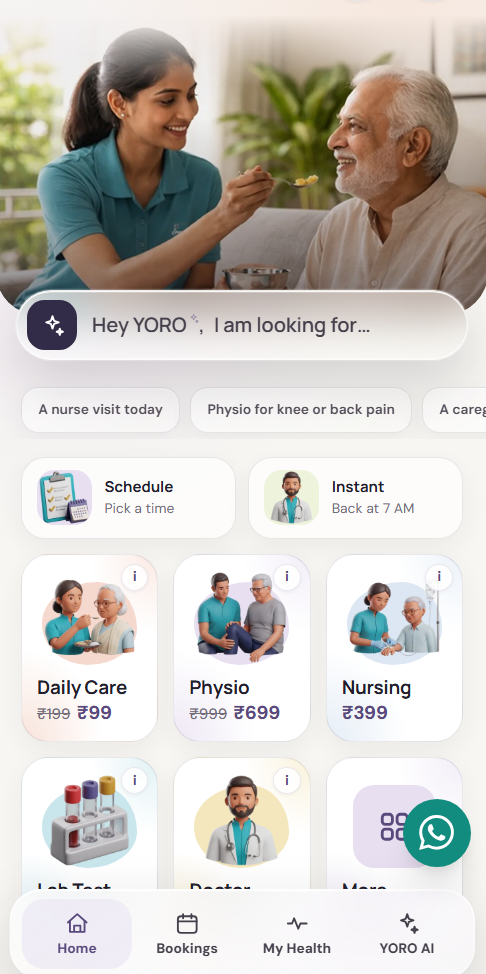
Today the work is grounded in hyperlocal operations and the day-to-day workflows of customers and care staff. We build the tools our own operations depend on: scheduling, visit coordination and the routines that keep care running consistently.
Today that means a home screen for booking and home-care services, and a care plan view where families and care teams track daily tasks, medicines and household signals.
This is the part of the product where reliability is the feature. If a visit slips, a family notices immediately.
03 · Live
Connecting the care journey
Live today.
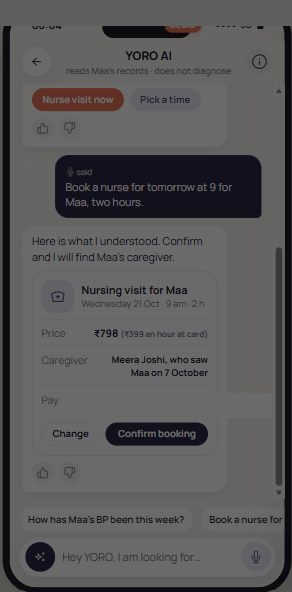
A single visit is a small part of a longer story. What happened last time, what the doctor advised, what the family noticed in between: that context matters.
Visits, household context and follow-ups now connect into a more coherent experience: the right information follows the right people, at the right time.
04
Why the engineering is interesting
Scheduling with real-world constraints
Matching the right professional, time and household isn't a calendar problem. It's a constraints problem with human edges.
Continuity across visits
Care quality depends on context surviving across visits, staff changes and time.
Capturing context where care happens
The most useful data is captured in the moment, by the people closest to the care.
Operational observability
If a visit doesn't happen, the team needs to know why before it escalates. Not after.
Permissioned workflows
Health information needs clear boundaries about who can see what, and when.
Failure in the real world
The interesting failures happen at doorsteps, not in dashboards.
05
Decisions and trade-offs
The hard decisions in this product aren’t about screens. They’re about where to spend attention. A few patterns have held so far:
Operational reality before polish
The first version of any workflow serves the people running it, not a demo audience.
Trust over convenience
In care delivery, a slightly slower flow that families and staff can verify beats a slicker one they can't.
AI where judgment keeps a paper trail
Automation that removes accountability is a risk. Humans stay in the loop where the stakes are high.
06 · Exploring
Where we’re going
Direction, not a product commitment.
Care context that travels: follow-ups and household context that survive individual visits, so the next person involved starts informed instead of from scratch.
Responsible AI: helping care teams act on information faster, without pretending to replace the people making care decisions.
Health intelligence over the long term: exploring how everyday health signals could support more proactive, responsible care. This is the longest horizon, and the one I’m most careful not to overpromise.
07
What I’ve learned
Real-world operations punish optimistic assumptions.
Every optimistic assumption about how care works in the field came back with an edge case.
Systems thinking is a founder's advantage.
Performance engineering taught me to look across layers. Building a company is the same discipline at a different scale.
Trust is built in small, repeatable decisions.
Families don't judge the architecture. They judge whether the next visit happens as promised.
Related
Where this thinking shows up in writing.
Essays on performance engineering, systems and product decisions are in the writing archive.