A field note from building YORO Health.
A medicine drawer tells you a lot about what is fragmented in healthcare at home.
Different prescriptions. Strips from different doctors. A half tablet somebody remembers being told to take. Another medicine that ran out before anyone noticed.
The information exists. It just isn’t organized in a way that helps a family get through an ordinary day.
At YORO Health, we’ve been working on one small part of this problem: turning a prescription photograph into something a family can actually use.
The starting point is familiar: a photo. From there, OCR and AI help extract medicine names, doses, and timings into a readable list. But reading a prescription is not the same as understanding it safely. Handwriting can be ambiguous; a dosage can be easy to misinterpret. The detected information must be reviewed and confirmed, rather than silently becoming an instruction.
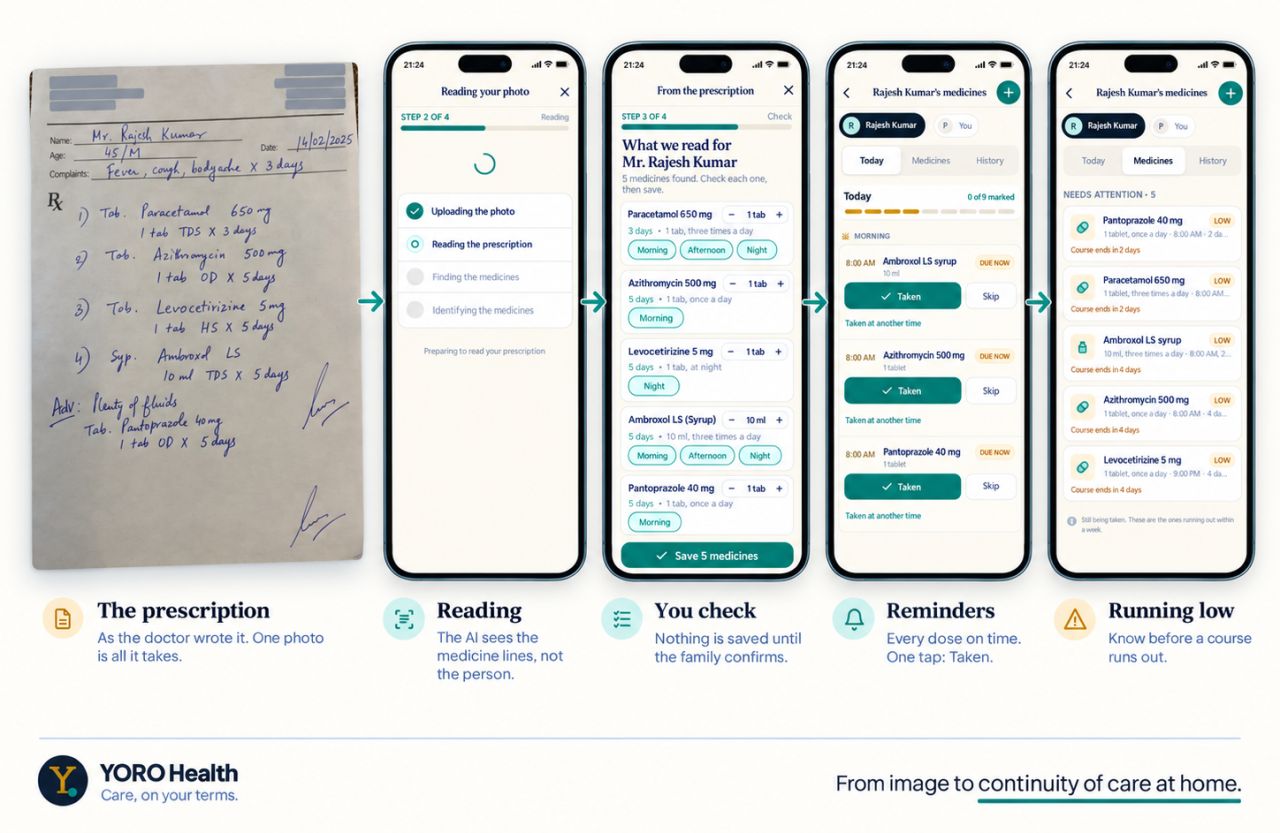
Once organized, that information can support the routine families live with: morning, afternoon, night, half tablets, reminders, and visibility into what has or hasn’t been marked as taken. A care team returning to the household can have better context than another image buried in a WhatsApp conversation.
That continuity is the part I find interesting.
A refill alert isn’t just a notification if it helps prevent a gap in someone’s routine. A medicine list isn’t just a digitized document if it helps the next care interaction start from what is already known. And an AI feature isn’t particularly useful unless the people depending on it can verify, correct, and trust the result.
The ambition isn’t to make a smarter medicine cabinet. It’s to help organize the small, disconnected pieces of healthcare at home so that each next action becomes easier.
Healthcare doesn’t become continuous because we collect more data. It becomes continuous when that context helps someone act.